Mailing List


Kevin Brazil
Kevin Brazil is a writer and critic who lives in London. His writing has appeared in Granta, The White Review, the London Review of Books, the Times Literary Supplement, Art Review, art-agenda, Studio International, and elsewhere. He is writing a book about queer happiness.
Articles Available Online


Interview with Sianne Ngai

Interview

October 2020

Kevin Brazil

Interview

October 2020

Over the past fifteen years, Sianne Ngai has created a taxonomy of the aesthetic features of contemporary capitalism: the emotions it provokes, the judgements...

Essay

Issue No. 28

Fear of a Gay Planet

Kevin Brazil

Essay

Issue No. 28

In Robert Ferro’s 1988 novel Second Son, Mark Valerian suffers from an unnamed illness afflicting gay men, spread by...

The apology had been the most charged and contested gesture between us, the common element in arguments whose subjects ranged from the trivial (courtesies, chores, choice of entertainment) to the significant (knowledge, character, politics, futures), though, as in any relationship, over time these categories of trivial and significant had become impossible to distinguish from one another, so that as a consequence we lived in a double state of nearly unbearable meaningfulness and meaninglessness – or, rather, forever suspended on the precipice of either: pre-meaningful or pre-meaningless What was unbearable, of course, was the extremity of each condition, but also the not-knowing in advance which condition would be applied (by us, naturally, but as if by some ‘outside agent’) to any given situation At times, it proved difficult to disentangle the act of, say, washing a plate to a lower-than-expected standard from the vast network of feeling and history in which all prior actions were somehow implicated On other occasions, feelings or memories which we had previously considered our ‘deepest’ or most important became somehow neutralised, or evacuated of significance, a phenomenon which we (or at least I) experienced with a weird elation I barely understood: sometimes, in the middle of what seemed to be a critical or even terminal conflict, a sudden tear or opening would materialise in the argument and through it would flood an understanding of its total inconsequence; thus we could find ourselves laughing, sometimes to the point of near-hysteria, at my total resistance to the idea of having children, or her ongoing trauma resulting from a sexual assault during adolescence, or any of the dozen or so other enduring obstacles to our happiness we thought of as ‘major issues’ Regardless of the ‘condition’ we found ourselves in, however, the apology was always a dangerous and unstable element to introduce In the former condition (of excessive meaning), its basic insufficiency or unreliability as a speech act guaranteed the irresolution, and often the escalation, of most conflicts ‘Sorry,’ I would say, not meaning it, having crunched a prawn cracker ‘too loudly’, and inevitably my non-belief in the

Contributor

March 2018

Kevin Brazil

Contributor

March 2018

Kevin Brazil is a writer and critic who lives in London. His writing has appeared in Granta, The White Review, the London...

Interview with Terre Thaemlitz

Interview

March 2018

Kevin Brazil

Interview

March 2018

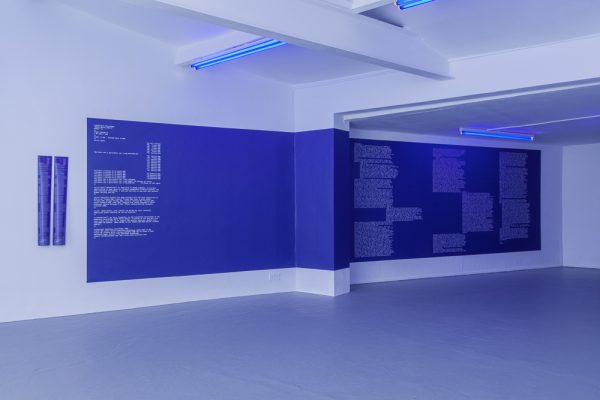
In the first room of Terre Thaemlitz’s 2017 exhibition ‘INTERSTICES’, at Auto Italia in London, columns of white text ran across one wall. Thaemlitz...

READ NEXT

Interview

March 2015

Interview with Jonathan Meades

Jamie Sutcliffe

Interview

March 2015

The television broadcasts of Jonathan Meades are marked by a surreal humour, a polymathic breadth of knowledge, and a...

fiction

January 2014

To Kill a Dog

Samanta Schweblin

TR. Brendan Lanctot

fiction

January 2014

The Mole says: name, and I answer. I waited for him at the indicated location and he picked me...

Art

June 2012

'The Freedom of Speech Itself', or the betrayal of the voice

Lorena Muñoz-Alonso

Art

June 2012

‘The instability of an accent, its borrowed and hybridised phonetic form, is testimony not to someone’s origins but only...


Get our newsletter


* indicates required