Mailing List


Kevin Brazil
Kevin Brazil is a writer and critic who lives in London. His writing has appeared in Granta, The White Review, the London Review of Books, the Times Literary Supplement, Art Review, art-agenda, Studio International, and elsewhere. He is writing a book about queer happiness.
Articles Available Online


Interview with Sianne Ngai

Interview

October 2020

Kevin Brazil

Interview

October 2020

Over the past fifteen years, Sianne Ngai has created a taxonomy of the aesthetic features of contemporary capitalism: the emotions it provokes, the judgements...

Essay

Issue No. 28

Fear of a Gay Planet

Kevin Brazil

Essay

Issue No. 28

In Robert Ferro’s 1988 novel Second Son, Mark Valerian suffers from an unnamed illness afflicting gay men, spread by...

Soviet Milk by Nora Ikstena opens with two women who cannot remember ‘I don’t remember 15 October 1969,’ says the first ‘I don’t remember 22 October 1944,’ says the second, ‘but I can reconstruct it’ They can only reconstruct what happened because these are the days on which they were born Birth reminds us that we are always dependent upon another to know the truth of who we are, something few of us ever come to terms with These two women are never named: the first, born in Riga in 1969 in the early years of Leonid Brezhnev’s rule over the Soviet Union, is the daughter of the second, born when Riga was liberated from the Nazis at the end of the Second World War This mother is also a daughter, born to a woman who resolved to forget the independent Latvia of her youth, and a father who refused to forget that Latvia condemned him to the gulag Soviet Milk consists of these two women telling their stories in short alternating sections, manifesting in its form the intimacy and distance of what the daughter calls their ‘two parallel worlds’   This is one among many instances of the ‘Soviet absurdity of parallel lives’ the daughter experiences while growing up, as she alternates between public enthusiasm for Soviet rule and private rebellion through studying Latvian poetry The absurdity ends when her generation re-achieves independence: ‘the return of their mother – the land of their birth’ But her mother cannot escape absurdity by being reunited with her nation, because absurdity is the condition of her existence ‘My birth obliged me to be alive: an absurd happenstance’ Unlike her daughter, identification with a nation does not provide an answer to the question that haunts her life: ‘There were so many who more than anything had wished to live but hadn’t been born Who decided this?’   Ikstena’s novel, which is lucidly translated by Margita Gailitis, was written as part of a series called ‘We Latvia The 20th Century’, comprised of thirteen novels telling the history of twentieth-century Latvia Ikstena has been publishing novels, essays, plays

Contributor

March 2018

Kevin Brazil

Contributor

March 2018

Kevin Brazil is a writer and critic who lives in London. His writing has appeared in Granta, The White Review, the London...

Interview with Terre Thaemlitz

Interview

March 2018

Kevin Brazil

Interview

March 2018

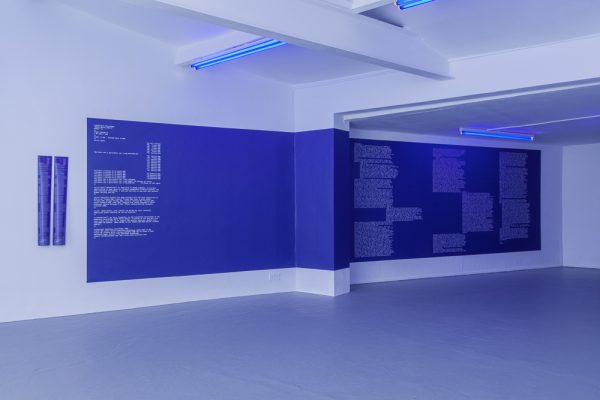
In the first room of Terre Thaemlitz’s 2017 exhibition ‘INTERSTICES’, at Auto Italia in London, columns of white text ran across one wall. Thaemlitz...

READ NEXT

feature

November 2015

Streets of Contradiction

feature

November 2015

Jerusalem has a remarkably cohesive identity, in architectural terms. Every building, from the Western Wall to the sleek hotels...

feature

November 2015

Anatomy of a Democracy: Javier Cercas

Duncan Wheeler

feature

November 2015

20 November marks the fortieth anniversary of the death of General Franco. And while the insurrectionist’s victory in the...

Interview

May 2011

Interview with Desmond Hogan

Ben Eastham

Jacques Testard

Interview

May 2011

Desmond Hogan is probably the most famous Irish writer you’ve never heard of. In the early 1980s, with numerous...


Get our newsletter


* indicates required