Mailing List


Kaleem Hawa

Kaleem Hawa has written about art, film, and literature for the New York Review of Books, The Nation, and Artforum, among others.


Articles Available Online


Hating it Lush: On Tel Aviv

Essay

May 2023

Kaleem Hawa

Essay

May 2023

I   They made the desert bloom, tall sparkling towers and clean Bauhaus lines, and apple-ring acacias, and teal blue shuttle buses, and stock...

Poetry

Issue No. 28

Three poems from issue 28

Sarah Barnsley

Valzhyna Mort

Kaleem Hawa

Poetry

Issue No. 28

Valzhyna Mort, ‘Music for Girl’s Voice and Bison’   Sarah Barnsley, ‘Virginia Woolf Has Fallen Over’   Kaleem Hawa,...

The ability of computers to semantically understand the world – and the humans in it – is next to nonexistent Computers are wonderful at crunching numbers, transforming data, and analysing the organisation of bits and bytes in any forms, but only in so far as those bits and bytes are complete in themselves When it comes to a holistic understanding of how that data relates to the world in which they live, computers remain inept, unable even to understand the rudimentary meanings of the English language Try to ask Google a question, rather than just punching in words to search for, and watch how quickly Google will run into difficulties understanding what question you’re asking It might know ‘What year was Obama born?’, but ask ‘What term is Obama in?’ and it cannot tell you ‘His second’   In the near-term seeking such human-level understanding is a futile endeavour In a previous article for The White Review, ‘Choose Your Own Formalism’, I wrote about the formal aspects of human-computer interaction in games: the ways in which the limitations of computer representation of characters and ideas place constraints on what can be done within the confines of digital interactivity These delineate the difficulties computers have in simulating – and thus in representing – human character and interaction   There is little cause for optimism in that regard The ability to create interactive analogues for the complexities of human activity and emotion are limited by the need to specify them to the very finest detail Unless a computer can ‘think’ like a human, which it certainly can’t, the only way for human-like interaction to take place is if the designers manually code up every variation and possibility, an endless, exhausting, and uncommercial task But there is a much richer vein of development, one that promises far more surprises and advances in the year to come I am talking about interactive modalities, the means by which we exert control over our player character counterpart within a game There is one catch, however, which is that it is entirely sub-rational and non-cognitive   When I

Contributor

November 2019

Kaleem Hawa

Contributor

November 2019

Kaleem Hawa has written about art, film, and literature for the New York Review of Books, The Nation, and...

after Mahmoud Darwish    Why is a boy an exclamation,  and why are his dead a period?,  why do his sinews tighten when he sees  a Palestinian body? Does his vision narrow  because of their flight,  or because their world is raining with salt?  Why is a boy with a gun different  from a boy with a jail cell?,  if the tools of rupture are our arms for  repurposing the body, and the arms of  the state are our means of repurposing the male,  are we finally useful and breathing and nervous…?  Does the white mean Night’s arrival?,  or does night signal the white’s escape?,  and when that white city boy becomes  a White City man,  does the hate in his heart subside?,  or does it become an ellipses,  a Bauhaus history of stories started  and left unfinished 
You Arrive at A White Checkpoint and Emerge Unscathed

Prize Entry

November 2019

Kaleem Hawa


READ NEXT

poetry

February 2013

Redacted, Redacted

Les Kay

poetry

February 2013

Here the censorship, which you’ve taught yourself, is self-inflicted (low sugar, low fat); it begins with the swinging shadow...

fiction

March 2011

In the Field

Jesse Loncraine

fiction

March 2011

There were flickers of red in the water, a tint the colour of blood. He stood in the river,...

Art

November 2014

Conversations About a Play

Louise Stern

Art

November 2014

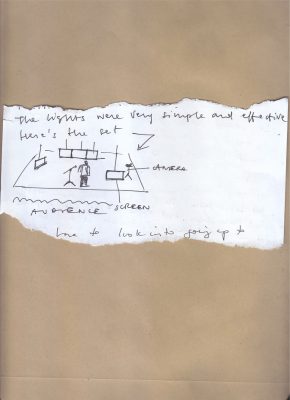
Editor’s note: The images in the slideshow document a conversation on paper between the writer and artist Louise Stern...


Get our newsletter


* indicates required