‘People always say you can’t change the past,’ suggests Sarah Moss in her interview in this issue, ‘but of course you can change the past completely, because you can tell a different story about it.’ Moss’s books, as Hannah Rosefield writes, ‘negotiate the past and imagine the future’: she discusses optimism, fridge-magnet clichés, the dangers of nationalist nostalgia (particularly in relation to contemporary nature writing), and how to ‘perform love by work’.
Several of Moss’s novels are written in the voices of children, a perspective – raw, unfiltered, perhaps unreliable, often seeking self-definition or belonging – which recurs throughout this issue of The White Review. In ‘Fried Egg’, a discomfiting story by Spanish writer Sabina Urraca (tr. Thomas Bunstead), a woman who has retreated to a haunted house in an attempt to disconnect from society recalls an incongruous childhood in a sinister anti-natal commune. Elvia Wilk’s essay ‘Kids in the Field’ dissects the knotty dissonance inherent in growing up as the child of anthropologists. Her unstable memories of her childhood in Belize – and her uncomfortable return – are interspersed with a nuanced examination of the anthropological discipline’s historical baggage, the sociological and emotional implications of growing up in a culture not your own, and the possibilities and limits of ‘assimilation’.
We publish new fiction – her first in two years – by Claire-Louise Bennett, a supermarket
reverie transporting us from the aisles of a suburban retail park to the velveteen splendour
of the Viennese opera. Fernanda Melchor’s essay ‘Veracruz with a Zee for Zeta’ (tr. Sophie
Hughes) examines life in contemporary Mexico through a series of violent vignettes set in
its beaches, nightclubs, supermarkets, streets and homes. Readers of Melchor’s explosive novel Hurricane Season will recognise her propulsive torrents of prose, her polyvocal narrative style, and her rage against power. ‘Extremity’ by Taiwanese writer Hsu Yu-Chen (tr. Jeremy Tiang) is an acerbic and poignant story of queer desire and loneliness: although in May 2019 Taiwan became the first country in Asia to legalise same-sex marriage, the elections of this January were characterised by virulently homophobic rhetoric directed at President Tsai Ing-Wen, who had signed the bill into law.
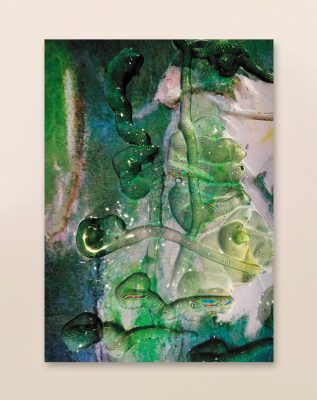
Rosanna Mclaughlin interviews artist Samara Scott, whose work collects and collages
used materials, from bath salts to Irn Bru, from fragments of glass to the ‘gutter totems’ of
cigarette butts and chewing gum. Scott’s interest in the tension between abstraction and
representation, and in blending disparate objects, colours and textures to dizzying effect,
is complemented by series from artists Lisa Oppenheim and Zhang Enli. Following an
acclaimed live performance hosted by The White Review and DRAF in November 2019, replete with projected gifs flickering on the walls, we present Johanna Hedva’s Nine Inch Nails hagiography ‘They’re Really Close to My Body’. Recalling their own experience of seeking identity and community in the era of dial-up and VHS, Hedva’s writing about music and mysticism, devotion and desire, transcendence and the unknowable, takes us to ‘a world where a language made of words can’t go’.