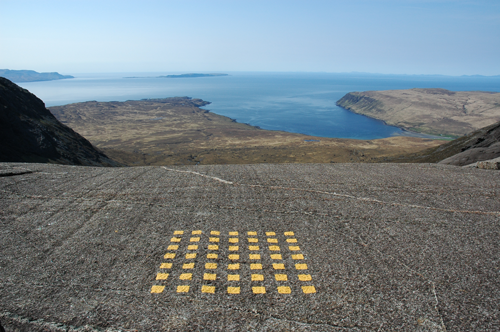
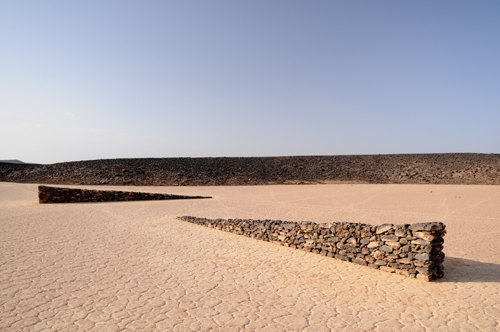
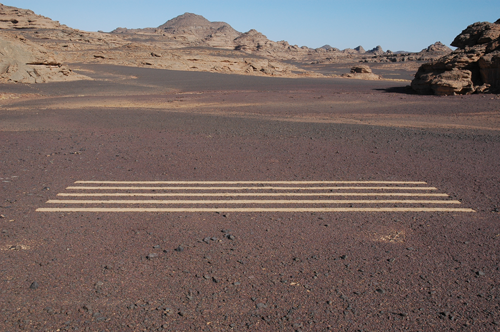
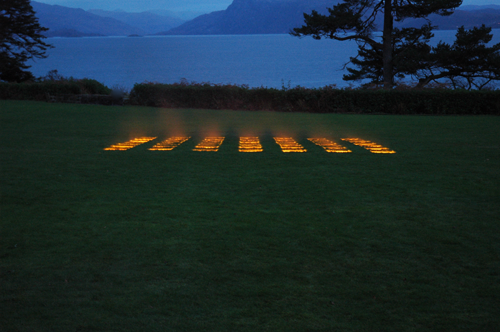
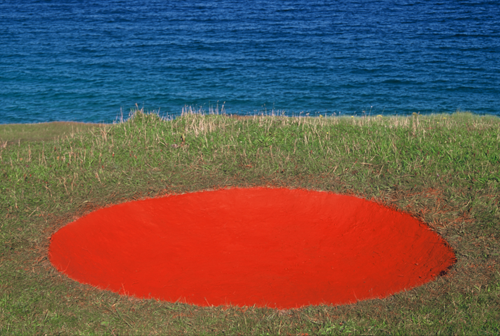
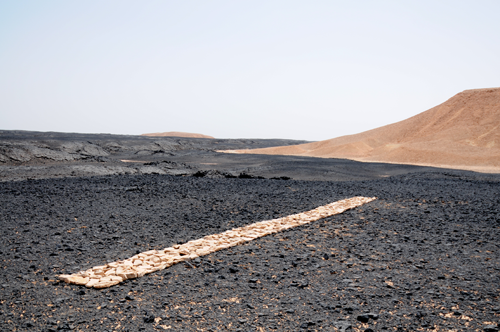
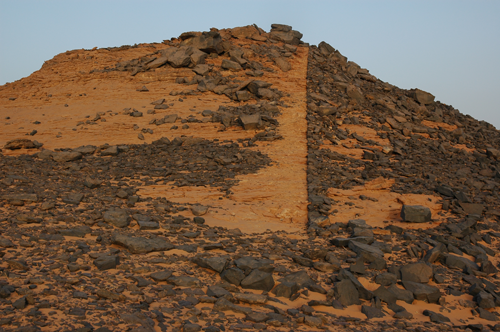
Julie Brook works with the land. Over the past twenty years she has lived and worked in a succession of inhospitable locations, creating sculptures that invest the wild terrains in which they are sited with a classical formalism. The artist draws the landscape, with the landscape, in the landscape.
In 1991 Brook moved to the uninhabited west side of the Scottish island of Jura, where she lived and worked for three years in what she calls a ‘natural arch’ and the rest of us would call a cave. From the mid-1990s she has spent much of her time on the similarly depopulated island of Mingulay, in the Outer Hebrides, and has more recently undertaken projects in the deserts of Libya (see her film River Bank 3) and Namibia, bringing her preoccupations with light, line and pictorial composition to these severe topographies.
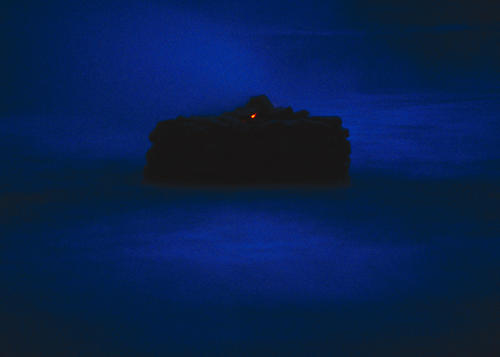
The most effective introduction to her practice is the remarkable film That Untravell’d World (1997), which documents the work made during her time on Jura. Prior to her move to the island the artist worked predominantly in paint, and this film charts her movement away from the form into a more direct engagement with her surroundings. Among the most memorable images is that of the artist plunging out into the coastal waters, alone aboard a raft in a storm, to keep alight the tottering ‘fire stacks’ she has built into the sea. These stacks are rock cairns built by hand at low tide, with a fire made of driftwood lit in a conical crater at their summit. As the tide comes in and the wind beats at the water the fires are threatened with extinction, their flames whipping light across the bay. The artist maintains these fires through the course of the night. Eventually, of course, the stack is toppled.
Julie Brook exhibited with Dovecot Studios, Edinburgh in April/May 2013.