Mailing List


Robert Assaye
Robert Assaye is a writer and critic living in London.

Articles Available Online


Issy Wood, When You I Feel

Art Review

December 2017

Robert Assaye

Art Review

December 2017

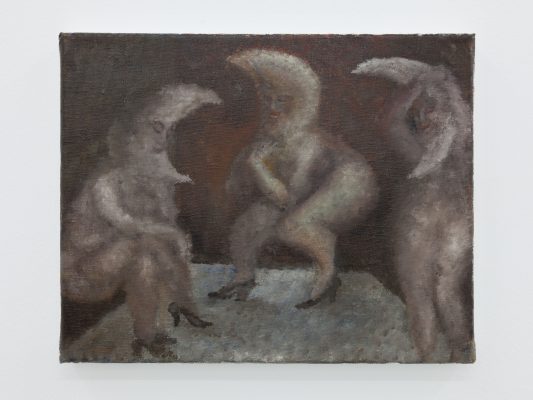
At the centre of Issy Wood’s solo exhibition at Carlos/Ishikawa is a room-within-a room. The division of the gallery into two viewing spaces –...

Art

April 2017

'Learning from Athens'

Robert Assaye

Art

April 2017

The history of Documenta, a quinquennial contemporary art exhibition founded in the German city of Kassel in 1955, is...

In his book Ways of Seeing, John Berger wrote, ‘Each evening we see the sun set We know that the earth is turning away from it Yet the knowledge, the explanation, never quite fits the sight’ The evidence of our own eyes jars with physical proofs, and we must rely on language to bridge the gap But before we are taught the explanation, the sight of the sun setting over the spinning world exists in a zone of slippage, where seeing something and knowing it to be true are different things   This is the best figure I have to describe the kind of world in which an English medieval dream poem takes place They are wonderful and strange environments, where what we read is not always easy or possible to visualise, and besides, everything means something else   Piers Plowman, the 14th-century multi-dream epic, is particularly difficult to follow It’s written in a tricky dialect of Middle English, and its unknown author tends to yank his ‘camera’ around wildly The poem begins with its narrator falling asleep in the Malvern Hills (he ‘slombred into a slepyng’), before his dream begins To the east, he sees a huge tower rising up to the sun, with a dungeon and deep ditches beneath it But then he sees something more: ‘A fair feeld ful of folk fond I ther bitwene / Of alle manere of men, the meene and the riche’ (‘I found a fair field full of folk, there in between / Of all manner of men, the mean and the rich’) The ‘eye’ of the poem wanders, zooming in and out, from the sun to a huge tower to a close-up of an individual man using a plough to till the earth If it were a movie, the reader would be seasick   Instability, shameless inconsistency, subtle paradox, resistance to visualisation: these are very medieval literary flavours The instability principle applies to medieval poetry but also, vector-like, to the way texts vary from manuscript to manuscript The scholar Paul Zumthor called it mouvance, the way that medieval texts – especially those that

Contributor

August 2014

Robert Assaye

Contributor

August 2014

Robert Assaye is a writer and critic living in London.

New Communities

Art

January 2017

Robert Assaye

Art

January 2017

DeviantArt is the world’s ‘largest online community of artists and art-lovers’ and its thirteenth largest social network. Its forty million members contribute to a...
The Land Art of Julie Brook

Art

Issue No. 4

Robert Assaye

Art

Issue No. 4

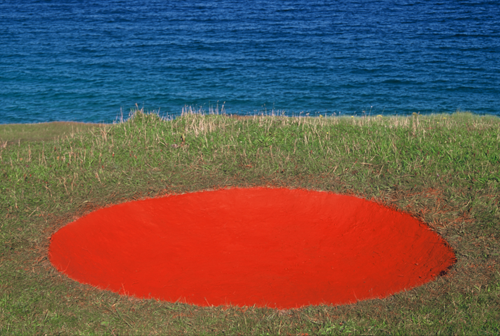
Julie Brook works with the land. Over the past twenty years she has lived and worked in a succession of inhospitable locations, creating sculptures...

READ NEXT

Interview

October 2015

Interview with Valeria Luiselli

Stephen Sparks

Interview

October 2015

Valeria Luiselli’s second novel, The Story of My Teeth, was commissioned by two curators for an exhibition at Galeria...

Interview

October 2013

Interview with Nick Goss

James Cahill

Interview

October 2013

Nick Goss has emerged in recent years as one of the UK’s most feted young painters. Evoking indistinct places...

Art

November 2015

None of this is Real

Anna Coatman

Art

November 2015

Rachel Maclean’s films are startlingly new and disturbingly familiar. Splicing fairy tales with reality television shows, tabloid stories, Disney...


Get our newsletter


* indicates required