The White Review

[Extract]

Interview with Paula Rego

,

Dame Paula Rego introduces me into her North London home with a crooked smile and a plate of biscuits. She is possessed of a sinewy, jagged vitality that manifests itself in laughter and gesture; there is a pixie-like physicality to her person that belies her tininess. She is considerate in her answers and kind in her manner, but never without a sense of play and shade.

Rego’s works invite the viewer into a world characterised by the collision of innocence and experience, a magical space in which, as in Velazquez’s Las Meninas, much is hinted at but nothing explained. Drawing on an imagination shaped by the fairytales she has treasured since her childhood, the sinister is here rendered seductive, the grotesque beautiful.

Before moving to London to study at the Slade, Rego grew up under the autocratic regime of Antonio Oliveira Salazar in an unbendingly Catholic Portugal. Themes of oppression, authority and institutional violence towards women recur in her work. In 2000 she was moved by a referendum on abortion in Portugal to produce a series of prints depicting women in suffering after a backstreet operation. The series was credited with helping to shift public opinion.

Her disdain for hierarchy and tyranny extends to her appreciation of the arts; alongside Degas and Dubuffet in her pantheon of influences stand Walt Disney and the great Victorian illustrators. In her determination to play down her own status as an artist she betrays her own disdain for distinctions between high and low culture.

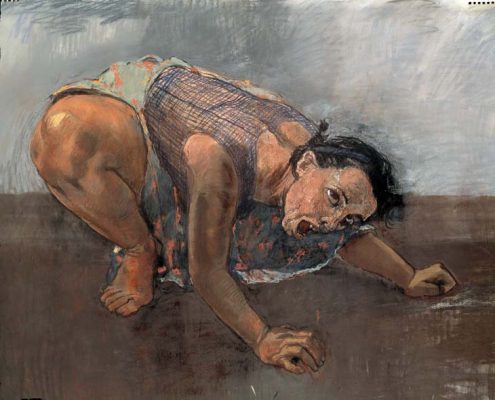
In her later work, Rego has worked with pastels on paper tacked to metal sheets, developing a technique of layered reapplication that brings an extraordinary depth to the medium. In addition to the figurative paintings for which she is most famous, she is also an accomplished drawer and printmaker.

Despite her own protestations, there is no doubt now that Paula Rego is among the great figurative artists of the post-war era. In 2009 a new museum dedicated to her work opened in Cascais, Portugal. It is called the House of Stories.
QThe White Review — Let’s start with your childhood and the tradition of storytelling that is so central to your work. Are there stories from your childhood that you particularly remember?

APaula Rego — I went to this school that was very bad, we never learned anything. But on Saturdays we had a meeting – like the German Youth, the Portuguese Youth, the fascists – we all wore uniforms, all the girls met, and we were supposed to learn lessons about fascism. So we all got together and talked about sex – we didn’t talk about fascism at all.

But the other girls told me a story – if you sit by the fire with the flames coming up late at night eventually you will see a face, and it is the face of the devil. And then when you go to bed you must be very careful to shut your door or leave it open, but to never leave it half open. So I then went to bed and I heard steps coming down the corridor next to my room. And the door was half open. And it opened and in came Death. Death came into my room. And she was the usual skeleton with a scythe – traditional Death. And I was terrified. I got out of bed and ran to my parents’ room and got into bed with them and shook and shook and then the door opened and Death came in and got into bed with us. And that is a nightmare that I have never forgotten. And that’s how the stories began, I’ve never forgotten that. The horror of it.

But before that, there’s a tradition in Portugal of telling children stories and folk tales, old folk tales, some of them extremely sinister – which I loved. When I was very little we had a country house. My grandmother lived there with some rabbits, she always had rabbits and chickens and geese and my grandfather’s sister used to go and spend the summer there with us. And she was brilliant at making up stories.She would tell me stories all afternoon. We would sit under the eucalyptus tree and she would say, ‘What kind of story would you like?’ and I would say, ‘Well, there is a princess and she had a father who loved her very much’ – the usual kind of thing that girls like. And she made up a story all afternoon, and then, when it was time for grown-ups to have cocktails and for us to wash our hands or something, then she would say, ‘We have to finish now and we’ll go on tomorrow’. And these stories lasted a week, sometimes. She could tell them in bits, you know. So I got used to stories, they were told to me all the time. And you know I didn’t read them, I was told them. That’s how it started, this interest in stories.


This is a short extract, the full article is available to read in Issue 1 [Click here to buy]

Copyright © 2013 The White Review
Site by Julian Mills