Over the last ten years graphic novels have undergone a transformation in the collective literary consciousness. Readers, editors and publishers alike have evolved their understanding of the form and its production from that of speedily consumed, largely superficial juvenilia to a serious-minded and technically complex undertaking.
Groundbreaking titles such as Art Spiegelman’s Mausand Joe Sacco’s Palestineearned the format a privileged place in the critical mindset by offering new representational possibilities for treating autobiographical accounts of conflict, war and trauma. Their work paved the way for a new generation of graphic novelists whose success in addressing these topics has raised the profile and standing of the graphic novel in the global literary arena.
The most prominent of this new generation is the Iranian artist Marjane Satrapi, whose autobiographical work on the 1979 Islamic Revolution has sold over two million copies, been translated into twelve languages, and prompted a film featuring Catherine Deneuve. Given its subject matter, such stratospheric success was unanticipated by its author, who has described how she had imagined simply distributing a few copies of the finished product among friends. Yet, in 2000, the first instalment of her four-part work Persepoliswas published in France by the alternative comic press L’Association to critical acclaim and commercial success. Three further instalments were published annually, and by 2003 the work had been picked up by Pantheon Books, translated into English, and went on to achieve global fame. But how is it that this individual story of conflict could have such universal appeal? And why are graphic novels so adept at conveying stories like Satrapi’s?
In order to understand the form today it is necessary to briefly reflect on its history and appreciate the vast development in the philosophy behind conflict illustration since World War II. Drafted artists such as Will Eisner and Jack Kirby were enlisted (with varying amounts of enthusiasm) to depict archetypal heroes who represented and validated the policy of the nation-state, whilst also serving the more practical function of instructing the troops in everything from weapon care to safe sex. In the post-war period, the mood inevitably developed into one of satire as wartime propaganda disintegrated when confronted with returning troops’ experiences. Over the next fifty years artists experimented with heroes, anti-heroes and superheroes, but it was not until these conventions and their associated value judgments were reconsidered that the form lent itself to autobiography and reportage. Given the form’s history, this of course provoked (and continues to provoke) critical suspicion of their political agenda, but the move in philosophy we have seen from archetype to individual, from individualism to community and from the lone voice to the polyvocal, has opened up a wealth of artistic possibilities that seem particularly adept at relating autobiographical tales of conflict.
In recent years, this has been made evident by the boom in comics production across the Middle East, with practitioners from, among other countries, Lebanon, Israel, Egypt and Syria receiving wide attention. Lena Merhej, co-editor of the multilingual, Beirut-based comics magazine Samandaland author of I Think We Will Be Calmer in the Next War, sees Persepolis as ‘a voice for many artists who are from the Middle East, especially those who live in the diaspora and are experiencing this cultural conflict,’ and Satrapi as ‘a role model for empowering personal narratives of a Muslim living outside [her country] and exposed to different cultures’. Reflecting on her own experiences, Merhej underlines the pragmatic aspect of comics’ success in the region: ‘Because comics combine words and images, and images allow you to insinuate a lot of things, the medium is very appropriate. Instead of directly saying “I was hurt”, you can show this in an image and the reader then has to do a lot of work to take [depictions of trauma] out. This allows you to talk about things which otherwise would have been censored.’
The genesis of Persepolis is familiar to its readers. Upon leaving Iran, Satrapi studied in Strasbourg at the École supérieure des arts décoratifs before moving to Paris. It was here that she became a part of L’atelier des Vosges, a comic book collective that counts a number of prolific French artists amongst its members. This period was a formative one for Satrapi, as it consolidated her dedication to comics as her chosen artistic medium, and, significantly, provided her first introduction to Art Spiegelman’s Maus. She has since cited this as the turning point at which she realised comics could be used to tell serious stories, and began to consider the form as a way to tell her own: ‘I realised that comics is not a genre, it is just a way of telling a story where I could feel exactly what was going on. Drawing is much closer to a human being than a photo, because you create the world in your own image: it’s very personal, it’s an international language. Before humans started talking, they first started drawing.’
The artist makes an ethical choice when deciding upon a medium through which to represent trauma and violence. In contrasting the drawn image with the photograph, Satrapi underlines the tension in trauma and post-trauma conflict narratives surrounding the ethics of representation, as well as drawing our attention to the capacity of comics to convey an individual way of seeing through the image. The opposition which she articulates between the realist and expressionist traditions occupies a central position in the discussion surrounding the depiction of trauma, where it can be argued that realistic representations degrade and intrude upon the memory of victims, debase the reader in fallaciously presenting an ‘objective’ account of events and diminish the seriousness of the subject through the external desensitisation induced by associated media images. The comic book format enables the author to avoid this problem, and Satrapi makes clear her position in this debate: ‘I write a lot about the Middle East, so I write about violence. Violence today has become something so normal, so banal – that is to say that everybody thinks it’s normal. But it’s not normal. To draw it and put it in colour – the colour of flesh and the red of blood, and so forth – reduces it by making it realistic.
Her statement is revealing in its rejection of realism as a mode that diminishes the subject and, importantly, that rejection is made as one speaking on behalf of her community. Although it is here ambiguous whether her ‘everybody’ is Middle Eastern, non-Middle Eastern or global, the preface to Persepolis makes it clear that one impetus for writing the work was to present an alternative vision of Iran to that of ‘fundamentalism, fanaticism, and terrorism’. Strongly implicated in the way that Iran is perceived externally are the stock images proliferated by media outlets, whose saturation desensitises their audience to images of violent conflict to the point of banality. By plunging the viewer into a new visual spectrum, comics as a non-realistic representation evade this problem. Equally, Satrapi wants to ‘ensure that those who gave their lives in the Revolution are not forgotten’. She is concerned that violent death may be inscribed as ‘normal’ in a Middle Eastern context, that ‘everybody’ will encounter the unknown dead as unremarkable subjects. It follows that, where this is so, loss becomes imbricated in communal experience of society, leading to a fragmentation of social consciousness where loss has not been fully mourned on a national and, often, individual basis.
In his polemical work Writing History, Writing Trauma, Dominick LaCapra underlines the central role which memory plays in dealing with traumatic events:
Through memory work, especially the socially engaged memory work involved in working through, one is able to distinguish between past and present and to recognise something as having happened to one (or one’s people) back then which is related to, but not identical with, here and now. Moreover, through mourning and the at least symbolic provision of a proper burial, one attempts to assist in restoring victims the dignity denied them by their victimisers.
As a mode, expressionism not only maintains an ethical distance by avoiding realistic representation, but its psychological nature enables the artist to move outside of the circumscribed boundaries of the ‘here and now’ and present that loss to the reader in such a way that clearly delineates the depiction as her ‘memory work’. Satrapi records the deaths of those close to her – including her uncle, neighbour and friends of her parents – as well as the deaths of those she knew either through acquaintance or not at all, for example depicting a massacre in one of Tehran’s cinemas by the Shah’s police and a massacre of political prisoners by the Guardians of the Revolution. This aspect of the socially engaged memory work affirmed by LaCapra should therefore be understood as both indicative of the author’s own moral choice to testify to the memory of those who were killed in the conflict, but also as a means of working through trauma. It should be remarked that, as one suffering from post-trauma, the sequence rendering her depression upon returning to Iran and learning from her father of the events which took place during her absence are a literate portrayal of the recognition LaCapra describes which, on a structural level, simultaneously functions to retrieve and articulate a counter-discourse.
In his polemic, LaCapra uses the example of the South African Truth and Reconciliation Commission to stress the importance of telling and being heard in a public sphere ‘in order for a process of working it through to be historically informed’. Considering this in relation to Persepolis, we can see that the authorial purpose is twofold: to retrieve the loss of the unremarked dead in a discursive sense for posterity and, in doing so, to challenge the state-prescribed national narrative through an exposition of the fragments imperceptibly woven through its logic. Critical to the process of re-telling is one of the comics genre’s strongest facets in conflict narratives: the ability to insert multiple examples of first-person speech into the text. With the caveat that the voices and statements appearing in the text are selective on the part of the author, this aspect of the form allows multiple voices to enter the text, leaving space for insight into others’ stories. This facilitates Satrapi’s concern with telling the story of a community, whilst the context this provides arguably bolsters our empathic engagement with the character, as we see something of our own lives – our own normality – in the scenes depicted. By reflecting the universal everyday, the work inverts the inscription of violence as normality and the reader fully recognises the horror of the events portrayed.
Satrapi’s form has not been universally appreciated by critics, some of whom have maligned what they perceive as a lack of technical complexity – and by extension artistic talent – in her work. As such, the initial critical reception to her characteristic black and white, clean-lined style often awkwardly avoided discussing its artistry, preferring instead to concentrate on the story of its charismatic, self-deprecating author. More recently, Hillary L. Chute has sensitively and intelligently illuminated this aspect of Satrapi’s work, demonstrating how she incorporates aspects of both the Persian and European traditions in her illustrative style: ‘[Renowned Persian art curator] Sheila Canby remarks that Persian painting “[favours] two-dimensionality and compositional harmony” and offers a “flat surface to form a rhythmic whole” – a quality we note throughout Persepolis that Canby asserts necessarily marks Persian paintings as exceeding mere mimetic representation.’
The incorporation of these qualities in Satrapi’s style, as in the traditional use of Persian miniature, illuminates the text whilst preventing the reader’s absorption in a mimetic image through its stylised, two-dimensional format, and interacts with the rest of the work to form a cohesive whole. From an artistic perspective, this aspect of the text enables the viewer’s eye to take in the image as a unified whole, rather than as a sum of parts, and in doing so creates an almost filmic effect. However, as Chute notes, the key difference in Satrapi’s work is the choice to work in black and white rather than the intricate and rich colour schemes of the classical Persian miniature, a choice which not only reflects the ethical concerns previously discussed but which conveys the European influence in her work, specifically that of German Expressionism.
Marjane Satrapi regularly cites films such as Fritz Lang’s Metropolis and F.W. Murnau’s Nosferatu as personal influences. Themes of class difference and oppression, the merging of fantasy with reality, the nightmarish aspect of her more violent panels, and the sense of profound alienation which comes across during the scenes of conflict and personal displacement are all aspects for which we find precursors in both films. Similarities in structure are also evident, with sudden dramatic climaxes and turns of fortune surprising the reader – a suddenness that reflects the nature of war. Indeed, while the film version of Persepolis was animated, her most recent graphic novel, Chicken with Plums, will be a live action feature produced at Babelsberg Studio, where both Nosferatu and Metropolis were filmed.
Taking this a step further, we can also postulate influences in the black and white woodcut prints of the Die Brücke graphic artists who worked in the expressionist movement, such as Karl Schmidt-Rottluff or Erich Heckel. Peter Selz describes the group as ‘driven by an inner need to utter personal feelings and emotions and to project unresolved conflicts in society’, which is exactly what Satrapi’s work achieves in its impulse to reveal the personal and communal trauma of those lost in the conflict of war, whilst criticising the conflict of inequalities across social groups. Like Schmidt-Rottluff, her work brings religion into direct contact with war, although unlike him this functions to interrogate the nature of divinity on a personal level and point up flagrant hypocrisies in the policies of the (then) new regime. In Heckel on the other hand, we see shades of Satrapi in what Selz describes as his ‘angular [and] nervous style… which achieved human images of great psychological insight and poetic sensitivity’. However, the most interesting parallel between Satrapi and Die Brücke is the overwhelming influence of World War I on their work; the majority of the group were drafted and, with reference to Serge Sabarsky’s volume on the subject (in which he describes the movement as, fundamentally, one of protest) we can identify a certain concretisation of form, economy of line and intensification of psychological matter in their post-war style which prefigures Satrapi’s.
Although her native country has a tradition of political cartoon satire (most famously, the exiled cartoonist Ardeshir Mohassess), the artist says it was her childhood reading of the European comics Tintin and Astérix that constituted her introduction to comics, although she laments their lack of assertive women characters. As an artist working in France, the history of the comics medium – or bande dessinée (BD) – has interesting implications for Satrapi’s work. Wendy Michallat charts the journey in their status from popular culture to a literature of protest, describing how the medium moved from Vichy propaganda to the preserve of the Catholic publishing house in the post-war period (Tintin falls under the latter). Subtle challenges to the didacticism of such works were made over the following decades, but it was not until the events of May ’68, when self-published anti-establishment BD exploded, that a real sea change took place. Michallat comments that ‘in this respect, it acquired the profile of popular culture in a traditional pre-mass-media sense of the word as an expression of belief specific to a community and one catalysed by dissident discourse.’ It is thus appropriate that Satrapi, whose concern with both community and protest has been discussed, should work in this medium, and that she should reject the term ‘graphic novel’ as one which attempts to build hierarchy into what she prefers to call ‘comics’.
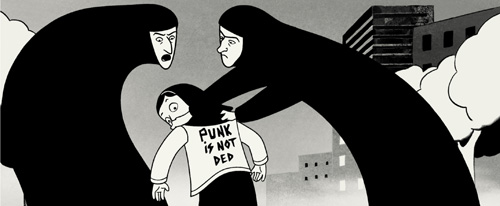
The issue of social equality is one that concerns the character of young Marjane throughout Persepolis. Brought up in a socialist household and educated with books on Karl Marx, she struggles to reconcile the teachings of her parents with their sometimes inconsistent behaviour, such as when her father forbids a relationship between their maid and a neighbouring boy on class grounds. This ideological conflict is made flesh when the family’s cleaning lady reveals that poor children as young as fourteen are being conscripted by the means of gold-coloured plastic keys – or ‘the keys to paradise’. The injustice of their fate is pathetically underlined in the juxtaposition of Satrapi’s panels: in the first, key-wearing children explode on the minefields; in the second she attends her first party in a fashionable punk rock top. The injustice in their respective fates, a result of class bias, does credit to the work’s intent that no loss of life should be forgotten.
However, Satrapi’s interrogation of European philosophy in a Persian context is not limited to Marx. She considers Simone de Beauvoir’s Le Deuxième Sexe in her coming-to-consciousness of herself as a feminist (most memorably, she tries and fails to urinate standing up) and later finds herself challenging the views of her anarchist friends in Vienna, whose populist interpretation of existentialism, ‘life is nothingness’, grates with her experiences of the life-threatening situations of war. The amusing pretentions of avowedly anarchist but essentially bourgeois adolescents blindly spouting Sartre is undoubtedly familiar to many readers, but the inclusion of this material also functions on a more serious level, in that it forms part of a wider cross-examination of Persian and European philosophies in the text. As an Iranian who grew up in Tehran, studied in Vienna and now lives in France, Satrapi is well-placed to draw subtle comparisons between cultural viewpoints and employs this world view to undermine generalisations, launch criticisms and demystify both cultures. Thus, when her anarchist friends dismiss giving one’s life for liberty as ‘a distraction from boredom’ in accordance with their misappropriation of existentialism, she counters: ‘So my uncle died to distract himself?’
Marjane Satrapi interweaves Persian and European influences to create a work which not only addresses war, trauma and conflict in such a way that creates empathic engagement in the reader, but does so using a sophisticated command of the intellectual, stylistic and formal traditions associated with these cultures. Close analysis of the execution of these suggests that a new strategy of reading is required where comics are concerned, one in which the reader is required to engage in an almost hermeneutical pursuit of meaning. Conversely, throughout this essay we have also seen the individualised and specific nature of the comics aesthetic, which enables works to elide the simplistic binaries and archetypes so many media outlets lazily recycle in the politicised words and imagery they employ in telling a country’s conflict. As a prominent and successful example of the genre, Persepolis is not mastered by, but itself masters, the traditions it draws upon. The path it has beaten in demonstrating the flexibility of this medium for cross- and intra-cultural representation has proven that comics are not purely a Western or Eurocentric medium, as some would have us believe, but rather constitute a global phenomenon which can masterfully harness all the richness and complexity of an artist’s cultural environs.